What Is an Invisible Induction Cooktop? The Minimalist Trend Reshaping Luxury Modular Kitchens in Gurgaon
Walk into a kitchen showroom in Gurgaon this year, and you'll notice something odd about the countertops. No hob. No control knobs. No dark glass panel breaking up the stone. Just a slab, uninterrupted from edge to edge, until someone sets a pan on it and it starts to cook.
This is the invisible induction cooktop, and it's quickly becoming one of the defining features of luxury modular kitchen design in Gurgaon. It's not a gadget or a novelty. It's a genuine shift in how premium kitchens are built, and it says a lot about where high-end residential design is headed in 2026.
What Is an Invisible Induction Cooktop?
An invisible induction cooktop is an induction cooking system installed beneath a porcelain or sintered stone countertop, rather than sitting on top of it as a separate unit. The coils, control electronics, and cooling components all live underneath the slab. From above, there's nothing to see, no rim, no glass panel, no printed markings until the surface is activated, at which point cooking zones are often indicated by a faint LED glow or subtle etching that disappears the moment you're done.
The countertop itself becomes the cooking surface. That's the whole idea.
How Is It Different From a Regular Induction Hob?
A standard induction hob sits in a cutout. You can see its glass-ceramic top, its control dial or touchpad, and the join where it meets the surrounding counter. It's a visible appliance embedded in your kitchen.
An invisible induction cooktop removes all of that from view. There's no cutout, no visible edge, no separate panel. The stone runs continuously across the entire counter, and the cooking hardware disappears below it.
One thing doesn't change, though, you still need magnetic-base cookware for either system to work. Copper-bottomed pans and most ceramic cookware simply won't heat up on an induction surface, visible or otherwise.
Why Are Invisible Induction Cooktops Trending in Luxury Kitchens in 2026?
Part of it comes down to a broader move away from busy, appliance-heavy kitchen surfaces toward calmer, quieter design. Buyers want their kitchens to look like considered spaces rather than a showroom of gadgets, and an unbroken slab does that in a way a visible hob never could.
There's also a material story here. Sintered stone and porcelain slabs have grown far more common in premium homes across Delhi NCR over the last few years, prized for their scratch resistance and heat tolerance. Once that material is already on the counter, hiding the cooking surface underneath it becomes a natural next step rather than a stretch.
Add in the rise of app-controlled kitchen hardware, and you get a feature that fits neatly alongside other things premium buyers are already asking for, flush cabinetry, hidden extraction, handleless drawers. The invisible cooktop is really just one more piece of technology that's been asked to stop looking like technology.
How Does an Invisible Cooktop Work Without Damaging the Countertop?
This is the part most people assume is impossible, and it's a fair assumption. Stone doesn't heat evenly, and most surfaces would crack under sustained induction heat. The reason this works comes down to two things: the specific composition and thickness of the slab material, and precise engineering underneath it.
Porcelain and sintered stone slabs used for this purpose are manufactured to tolerate rapid, localised heat without expanding or fracturing, something ordinary granite or marble generally can't do reliably. Below the slab, the coil assembly, wiring, and thermal cutoffs are set into a reinforced housing with dedicated ventilation channels, so heat generated during cooking is managed and dissipated rather than allowed to build up against the underside of the stone.
None of this is something you retrofit casually. It requires the same kind of structural precision that goes into cutting a cabinet carcass to exact load tolerances — the margin for error is small, and it has to be accounted for at the manufacturing stage, not adjusted on-site.
Which Kitchen Layouts Work Best With an Invisible Induction Cooktop?
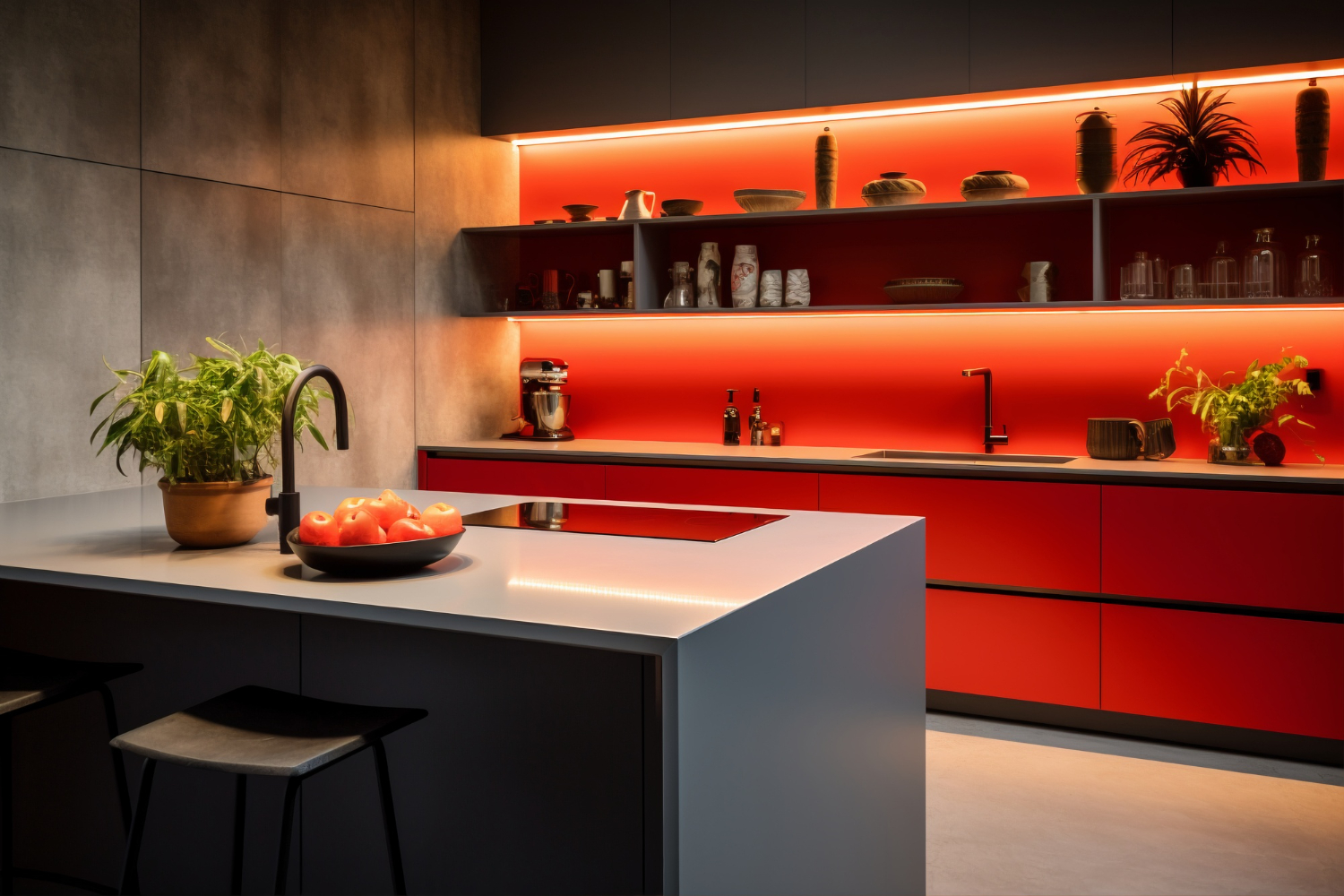
Islands and peninsula counters make the most sense for this feature, simply because they're the surfaces people look at from every angle. A visible hob in the middle of an island tends to break up the design more than one on a wall-mounted run would, so that's where hiding it pays off the most visually.
That said, it isn't limited to islands. It works just as well as part of a continuous countertop run in L-shaped, Island, or Italian-style layouts, provided the layout is planned with the cooktop's placement in mind from the start.
Also Read: What Should You Check Before Accepting a Newly Installed Modular Kitchen?
Is an Invisible Induction Cooktop Easy to Maintain?
Yes, arguably easier than a standard hob. There's no rim, no seam, and no raised edge for spills to collect against. Since the cooking surface is flush with the rest of the counter, wiping it down is no different from cleaning any other section of stone.
The only real maintenance consideration is on the cookware side, using pans with flat, magnetic bases keeps the surface heating evenly and avoids unnecessary wear over time.
Can an Invisible Induction Cooktop Be Added to an Existing Countertop?
Generally, no. This isn't something that gets fitted into a counter you already have. Because the coil housing, ventilation, and structural reinforcement all need to be built into the slab and the cabinetry beneath it, this has to be planned at the countertop fabrication stage, not added afterwards.
If you're renovating and want this feature, it needs to be part of the design brief from day one, not a decision made once the kitchen is already built.
How Much Does an Invisible Induction Cooktop Add to a Modular Kitchen Budget?
This sits firmly in premium-upgrade territory rather than a standard inclusion. Between the specialised slab material and the underlying engineering, it costs meaningfully more than a conventional built-in induction hob.
The exact number depends on your layout, slab size, and how much of the counter run is involved. If you're working out where this fits into your overall renovation budget, running your layout through a modular kitchen cost calculator first gives you a realistic baseline before you start adding premium features like this on top.
How Does Novella Kitchens Build Invisible Induction Into a Modular Kitchen Design?
Getting this right isn't just about sourcing the right slab, it's about the manufacturing discipline behind it. As one of the modular kitchen manufacturers in Gurgaon working entirely out of an in-house production facility, we're able to account for a feature like this from the first design conversation rather than trying to bolt it on later.
It starts in the design studio, during the 3D spatial planning stage, where the countertop, the cabinetry underneath it, and the ventilation requirements all get mapped together before anything is cut. That coordination matters more here than on almost any other feature, because there's very little room to adjust once the slab is fabricated.
If you're planning a kitchen renovation in Delhi NCR and this trend has caught your eye, it's worth bringing up early as a modular kitchen manufacturer in Delhi and Gurgaon, we'd rather plan for it from the start than try to explain later why it can't be added in.
The Takeaway
Invisible induction cooktops are a good example of where luxury kitchen design is actually headed not toward more visible technology, but less of it. The engineering gets more sophisticated while the surface gets simpler to look at. For anyone exploring a luxury modular kitchen in Gurgaon this year, it's one of the clearer signals of what "premium" is starting to mean.
If you're curious what a feature like this would cost within your own layout, our modular kitchen cost calculator is a good place to start, or you can book a design consultation with our team directly.
Frequently Asked Questions
Q1 Is an invisible induction cooktop safe to use?
Yes. The coil assembly sits inside a reinforced housing with thermal cutoffs and ventilation built in, so heat is regulated the same way it would be in any certified induction system — the difference is just that the housing sits under stone instead of inside a visible unit.
Q2 Do I need special cookware for an invisible induction cooktop?
Yes, the same rule applies as with any induction surface you need pans with a flat, magnetic base. Copper, aluminum, and most ceramic cookware won't heat up on induction at all, visible or hidden.
Q3 Can I install an invisible induction cooktop myself or does it need a specialist?
It needs to be planned and installed by the kitchen manufacturer at the fabrication stage. Because the coil housing and ventilation are built into the slab and cabinetry together, this isn't a feature a local electrician or carpenter can add on afterward.
Q4 Does an invisible induction cooktop work with all types of stone countertops?
No. It requires a slab material engineered to handle localized heat without cracking or expanding, which is why porcelain and sintered stone are used rather than natural granite or marble.
Q5 How long does it take to build a modular kitchen with an invisible induction cooktop?
It doesn't significantly extend your timeline if it's part of the original design brief. Since Novella Kitchens plans this at the 3D spatial planning stage, it's factored into the same manufacturing and installation schedule as the rest of your modular kitchen.
Q6 Is an invisible induction cooktop worth the extra cost?
That depends on how much you value an uninterrupted countertop look. It's a premium upgrade rather than a functional necessity cooking performance is comparable to a standard built-in induction hob, so the value is largely in the design.