Why Modular Kitchens Fail in Gurgaon: MDF vs BWP Plywood Guide
A kitchen cabinet shouldn’t sag after three years, yet it is the single most common complaint in Gurgaon high-rises. You spend months agonizing over the perfect matte acrylic finish, coordinating the countertop with the backsplash, and finalizing the layout, only to watch the under-sink shutters crumble after one heavy monsoon season.
The harsh reality of the interior design industry is that almost all modular kitchens look identical on the day of installation. The glossy exterior hides the structural truth. The failure always happens on the inside, hidden behind the sleek hardware and beautiful laminates. When homeowners face modular kitchen problems in Gurgaon, it rarely has to do with aesthetic choices. It has everything to do with cheap core materials, poor load-bearing calculations, and the fatal flaws of manual carpenter execution.
If you are planning a renovation or building a new home in Delhi NCR, understanding the mechanics of kitchen failure is the only way to protect your investment. Here is exactly why kitchens break down, and how Novella Kitchens engineers our layouts inside our 11,000 sq. ft. facility to survive intense daily utility.
Quick Answer: Why Do Modular Kitchens Fail?
If you are currently researching the best modular kitchen manufacturer in Gurgaon, you need to screen vendors against these five common engineering flaws:
- Wrong Core Material: Using highly porous MDF or standard particle board in wet zones instead of waterproof BWP marine plywood.
- Manual Edge Banding: Carpenters using heat guns and white glue, leaving micro-gaps where water and steam penetrate the core.
- Weak Load Tolerances: Standard base panels buckling under the weight of heavy Indian cookware and bulk grocery storage.
- Poor Appliance Ventilation: Trapping heat behind built-in ovens and microwaves, leading to localized cabinet warping and fire hazards.
- Ignored Ergonomics: A broken "work triangle" that turns daily meal prep into an exhausting chore.
5 Reason Modular Kitchen Fail in Gurgaon
1. The Under-Sink Collapse: MDF vs. BWP Marine Plywood
The number one cause of kitchen failure in Delhi NCR is water damage. Standard MDF (Medium Density Fiberboard) and particle board act exactly like rigid sponges. A minor RO filter leak, condensation from a cold pipe, or the daily splashing from washing utensils is all it takes for these materials to fail. They absorb atmospheric humidity, swell up to twice their thickness, and eventually rot away into a powdery mess.
Many local contractors and budget brands try to cut costs by using MR (Moisture Resistant) grade plywood. Do not be fooled—moisture resistant is not waterproof.
At Novella Kitchens, we completely eliminate MDF and standard commercial ply from all sink and washing zones. We strictly utilize Boiling Water Proof (BWP) marine plywood for the core structure. True BWP plywood is manufactured using undiluted phenol-formaldehyde resin, making it structurally dense, completely waterproof, and immune to delamination even if submerged in boiling water for 72 hours.
By utilizing heavy-duty BWP marine plywood, we guarantee structural integrity against Gurgaon's intense monsoon humidity and the realities of a heavy-use Indian kitchen.
2. Peeling Laminates and Water Ingress
You have likely seen it in a friend's home or an older apartment: a beautiful cabinet door where the edge tape starts lifting at the corners, exposing the rough, raw wood underneath. This isn't just an eyesore; it is a structural death sentence for the cabinet.
This happens because local carpenters and semi-modular setups use manual hand-pasting methods for edge banding. They apply standard white adhesive and press the tape on by hand or with a basic heat gun. This primitive method leaves microscopic gaps along the edges. Every time you boil water, use the pressure cooker, or wipe down the cabinets, steam and moisture enter these gaps. Over a few short months, the moisture degrades the adhesive, causing the laminate to peel away.
This is the exact reason why Novella Kitchens relies exclusively on Homag CNC kitchen manufacturing. Inside our Gurgaon facility, advanced German machinery applies industrial zero-joint edge banding.
We use high-grade Polyurethane (PU) glue applied under immense machine pressure. This creates a permanent, waterproof lock around the core board.
- Zero Moisture Entry: Steam, water spills, and airborne cooking oils cannot penetrate the edges.
- Pest Proof: No microscopic gaps mean termites and cockroaches cannot find entry points to nest inside the cabinetry.
- Flawless Finish: The transition from the laminate face to the edge band is seamless, replicating high-end European aesthetics.
3. Sagging Drawers Under Heavy Indian Cooking Loads
The functional demands of an Indian kitchen are vastly different from a Western one. We store heavy cast-iron tawas, massive pressure cookers, 10-kilogram atta drums, and bulk spices.
Most standard, pre-fabricated cabinets are simply not engineered to handle this concentrated weight. When you place 30 kilograms of lentils and grains into a poorly constructed drawer, the base panel sags. The cheap telescopic channels warp. Within a year, the drawer misaligns, jams halfway, or completely derails from its track.
Solving this requires moving beyond standard carpentry into actual load-bearing engineering. Every unit manufactured by Novella Kitchens is built with strict weight tolerances. Our appliance and storage carcass units feature double-layer reinforced support panels. We do not use generic, unbranded channels. We pair our BWP cores with cycle-tested, heavy-duty hardware (such as Hettich or Blum) rated for 40kg to 65kg dynamic loads. These drawer systems refuse to buckle under pressure, ensuring a smooth, soft-close operation even when fully loaded a decade down the line.
4. The Broken Ergonomic Work Triangle
A visually stunning kitchen that forces you to walk ten steps between the refrigerator, the sink, and the stove is a failed kitchen. Poor spatial planning is one of the most frustrating, yet least talked about, design problems.
Many homeowners accept the builder-provided layout of their Gurgaon apartments without questioning the workflow. A kitchen must be divided into intelligent zones: Consumables (fridge/pantry), Preparation (counter space), Cooking (hob/oven), and Cleaning (sink/dishwasher).
Before cutting a single board, our field specialists map your exact architectural constraints using laser measurements. Our design team analyzes your floor plan to engineer an optimized "work triangle" tailored precisely to how you move. We calculate clearance zones to ensure appliance doors don't block walkways, guarantee that prep zones are logically connected to the cooking station, and maximize vertical storage without making the space feel claustrophobic.
5. The "Hidden" Appliance Heat Trap
Modern luxury kitchens seamlessly integrate heavy appliances—built-in microwaves, OTG ovens, espresso machines, and dishwashers. However, integrating these machines into standard wooden cabinets without adequate thermal planning is a massive fire hazard and a fast track to cabinet failure.
Appliances generate intense, concentrated heat. If an oven is shoved into a tightly sealed MDF box, that heat has nowhere to go. The trapped heat bakes the surrounding wood, drying out the adhesives, warping the laminate, and drastically reducing the lifespan of the appliance itself due to overheating.
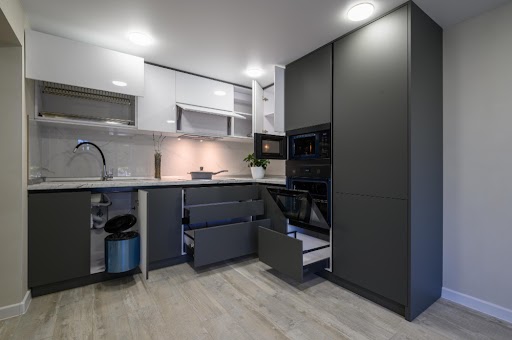
Our appliance carcass units are explicitly engineered with thermodynamic flow in mind. We design specialized rear ventilation loops and clearance channels behind the cabinetry. This allows for proper heat dissipation and continuous airflow, protecting both your expensive appliances and the structural integrity of the surrounding wood.
Also read: Your Go-To Guide for Kitchen Cabinet Materials and Finishes
The Ultimate Verdict: Factory Execution vs. Local Carpentry
The debate for homeowners usually comes down to initial cost. A local carpenter will often quote a lower upfront price. But the long-term math heavily favors factory precision. A carpenter-built kitchen that needs the sink base replaced in two years, and new hinges in three, is significantly more expensive than a factory-engineered kitchen that requires zero maintenance.
|
Feature |
Novella Factory-Engineered |
Local Carpenter Execution |
|
Manufacturing Setup |
11,000 sq ft facility, Homag CNC |
On-site manual hand tools |
|
Edge Banding |
Zero-joint PU sealing (waterproof) |
Manual pasting (prone to peeling) |
|
Precision & Finish |
Millimeter accuracy, flawless lines |
Relies on manual visual measurements |
|
Installation Timeline |
Pre-assembled, 3-5 days on site |
Weeks of on-site dust, noise, delays |
|
Core Material Guarantee |
Certified BWP Marine Plywood |
Variable, often mixed with cheap MDF |
When searching for the best material for modular kitchen in Gurgaon, you are essentially looking for a partner who understands that a kitchen needs to function flawlessly in year ten, not just look good on day one. By managing the entire process in-house and backing it with a comprehensive modular kitchen structural warranty, Novella Kitchens ensures your investment is actually built to last.
Frequently Asked Questions (FAQ)
Q1. Why do kitchen cabinets swell in the monsoon?
Kitchen cabinets swell when they are built using low-density, porous materials like MDF or commercial particle board. These materials rapidly absorb atmospheric humidity and moisture from daily washing, causing the core structure to expand, warp, and permanently lose structural integrity.
Q2. What is the best core material for modular kitchens in Delhi NCR?
The best core material for modular kitchens in Delhi NCR is Boiling Water Proof (BWP) marine plywood. It is structurally dense, completely waterproof, and naturally resists moisture retention, preventing the cabinets in wet zones from degrading over time.
Q3. Why is my kitchen laminate peeling at the edges?
Kitchen laminate peels because manual hand-pasting methods leave microscopic gaps along the edges. Steam, oil, and moisture enter these gaps during daily cooking, degrading the adhesive over time and causing the laminate to detach from the wood core.
Q4. Is a factory-made kitchen better than a local carpenter?
Yes, a factory-made kitchen provides superior longevity and precision. Factory-engineered kitchens utilize computer-controlled CNC machinery for millimeter-perfect cuts and industrial zero-joint edge-banding. This ensures heavy load-bearing capacity and a structural stability that manual hand tools simply cannot replicate.
Q5. Can custom factory kitchens accommodate heavy Indian cooking?
Absolutely. Factory kitchens can be engineered with double-layer reinforced base panels and cycle-tested hardware specifically rated to bear the weight of heavy cast-iron cookware and bulk grocery storage without sagging.