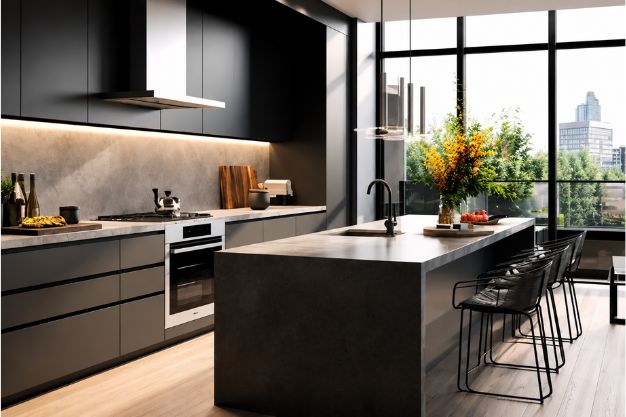
What Are the Best Materials for a Modular Kitchen in India? (2026 Guide)
Quick answer: The best modular kitchen materials in 2026 are BWR-grade plywood for cabinet carcasses, ultra-matt laminates or PU lacquer for door finishes, engineered quartz or sintered stone for countertops, and German-brand soft-close hardware. WPC panels work best in high-humidity or coastal zones. The right combination depends on your budget, layout, and local climate.
Walk into a ten-year-old kitchen built with the wrong materials, and you'll know immediately. Doors that sag. Countertops gone chalky near the hob. Laminate peeling at the edges. Now walk into one built right, same age, same daily use, and it still looks like a showroom.
That difference isn't luck. It's material selection.
This guide covers cabinet cores, door finishes, countertops, hardware, and real cost ranges—everything you need to make a decision that holds up for a decade.
How To Choose Modular Kitchen Materials: 5 Performance Factors That Actually Matter
Before browsing catalogues, anchor every decision in these criteria.
- Moisture resistance: Indian kitchens face daily pressure cooking, monsoon humidity above 80%, and a constantly running sink. A material that can't handle this will swell and delaminate, and no amount of beautiful finish will save it.
- Load-bearing strength: Base cabinets support stone countertops weighing 40–60 kg per running metre. The carcass needs genuine density and screw-holding capacity, not just surface hardness.
- Dimensional stability: Delhi temperatures swing from 4°C to 45°C. A cabinet built with an unstable core will have misaligned doors by year two. This is where the precision of German CNC manufacturing, the Homag and Altendorf machines Novella uses, makes a real and measurable difference.
- Finish adhesion: The most beautiful laminate is only as good as its bond with the substrate. Poor adhesion means peeling edges within 18–24 months. Material quality and surface preparation both matter.
- Indoor air quality: Most sheet materials off-gas formaldehyde from their binders. E0/E1 (European) and ISI certification (Indian) set safe residential limits. Always ask your manufacturer for emission documentation.
Which Material Is Best for Modular Kitchen Cabinet Carcasses in India?
BWR-grade plywood: the gold standard
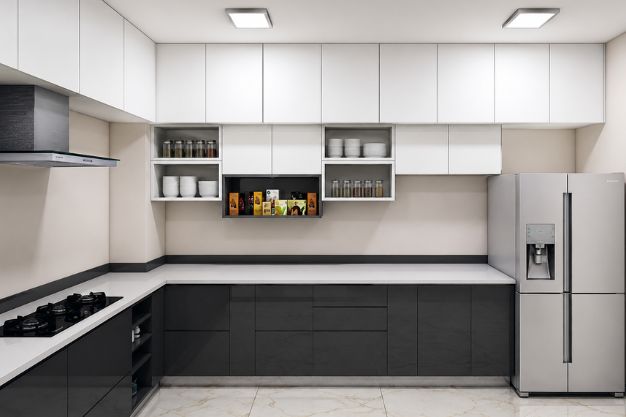
Boiling Water Resistant plywood remains the best all-round carcass material for Indian kitchens in 2026. It handles moisture without swelling, holds screws firmly after years of use, and withstands the thermal cycling that Indian kitchens experience. A properly edge-banded BWR plywood carcass comfortably lasts 10–15 years.
It costs 15–25% more than particleboard, but on a cost-per-year basis it almost always works out cheaper. Novella uses 18mm BWR-grade plywood as standard for all carcasses, with 2mm ABS edge banding on every exposed edge.
MDF: excellent for doors, not carcasses
MDF's uniform, grain-free surface is the best possible base for PU lacquer and painted finishes. As a carcass material in Indian kitchens, however, it absorbs moisture, swells at the edges, and loses its screw-holding near water sources. Use it for door shutters, not for base cabinets.
HDF: the overlooked middle ground
High-density fibreboard is denser and harder than MDF. It holds fasteners better, handles mechanical stress better, and has better dimensional stability.
For drawer boxes, base cabinet floors, and internal shelving in mid-range kitchens, HDF is a compelling material. It's not perfect in wet zones, but with good edge banding it performs reliably in most Indian kitchen environments.
Best for: Internal components, drawer bottoms, shelf inserts, upper cabinet carcasses in dry zones.
WPC: the rising material
Wood Polymer Composite is completely waterproof and practically termite-proof. For coastal cities like Mumbai and Chennai, or for basement kitchens with ground moisture issues, WPC is increasingly the first-choice carcass material. The limitation: lower screw-holding than plywood, requiring specialised fasteners. Premium variants with reinforced cores largely resolve this.
Particle board: entry-level only
Low density, low screw-holding, swells irreversibly with moisture. It's the most common material in flat-pack systems and the most common reason kitchens need early replacement. Appropriate for rental properties or utility spaces. Not recommended for primary residential kitchens. Apparent savings at purchase often turn into a higher real cost over time.
|
Material |
Moisture Resistance |
Load Strength |
Dimensional Stability |
Finish Adhesion |
Emission Safety |
Novella Rating |
|
BWR Plywood |
Excellent |
Excellent |
Very Good |
Very Good |
Very Good |
First choice |
|
MDF |
Fair |
Good |
Good |
Excellent |
Very Good |
Doors only |
|
HDF |
Good |
Very Good |
Very Good |
Excellent |
Very Good |
Drawers & base |
|
Particle Board |
Fair |
Fair |
Fair |
Good |
Good |
Basic builds only |
|
WPC |
Excellent |
Good |
Excellent |
Good |
Excellent |
Wet zones & coastal |
What are the Best Door Finishes in 2026 for a Modular Kitchen in Gurgaon
Ultra-matt laminates: the dominant choice
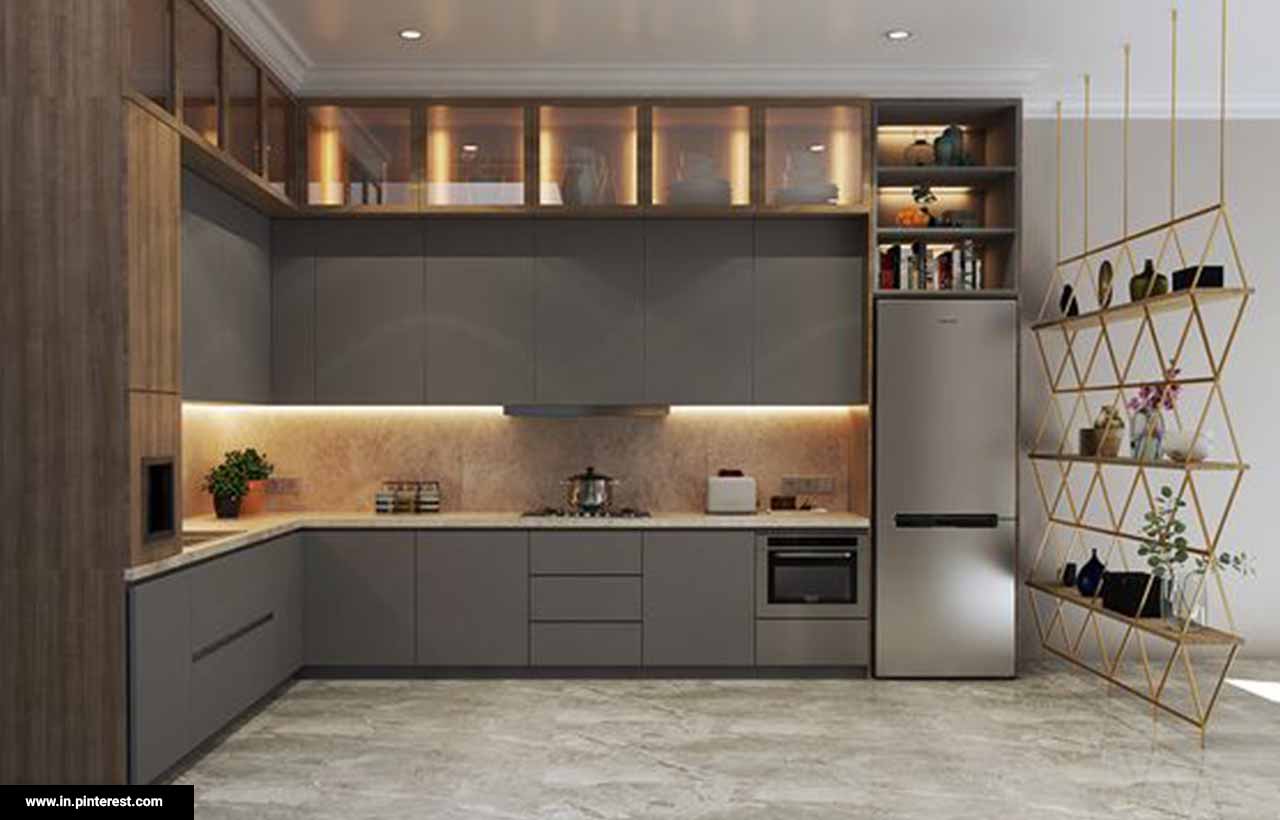
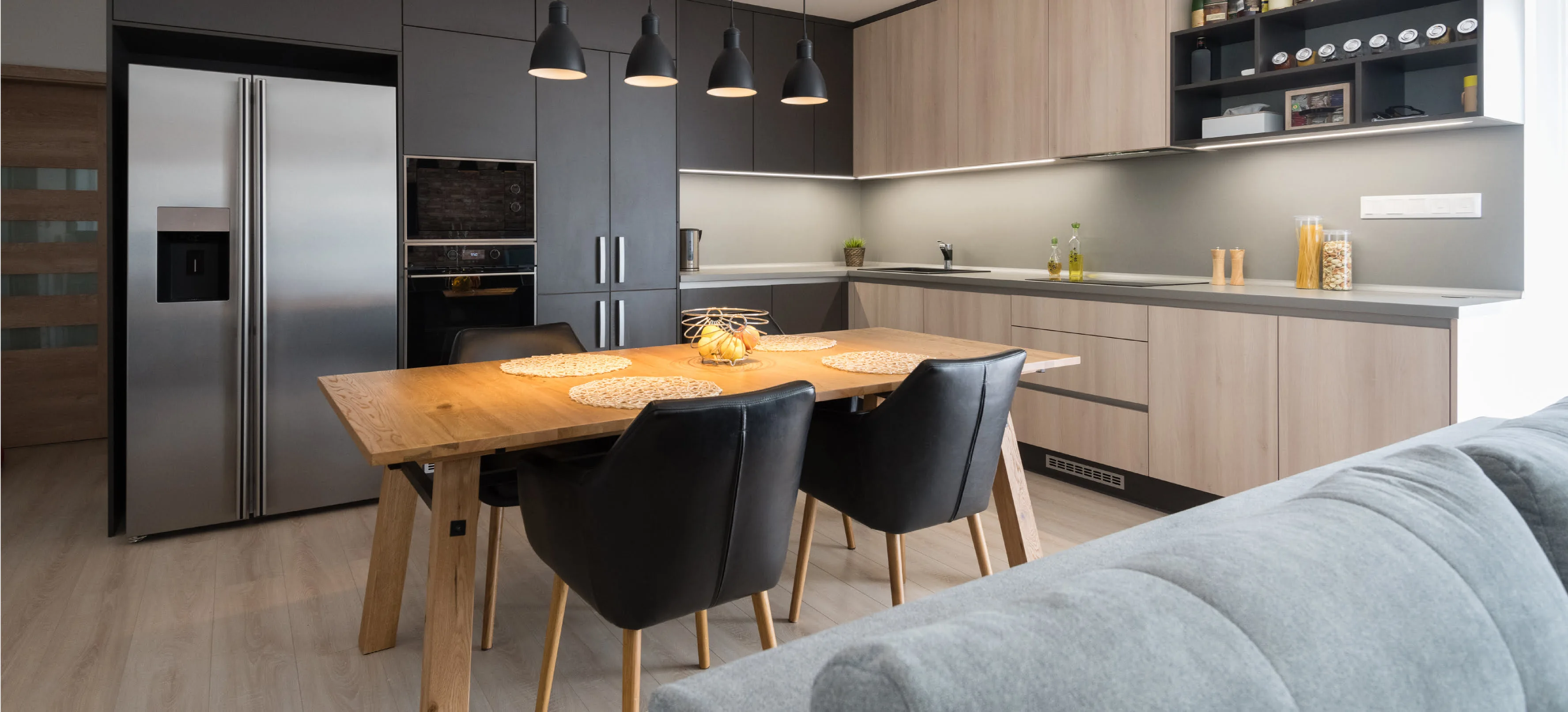
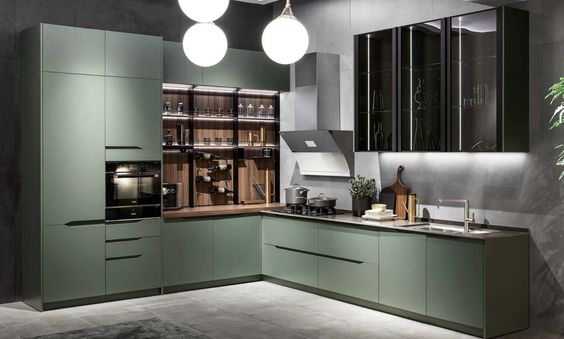
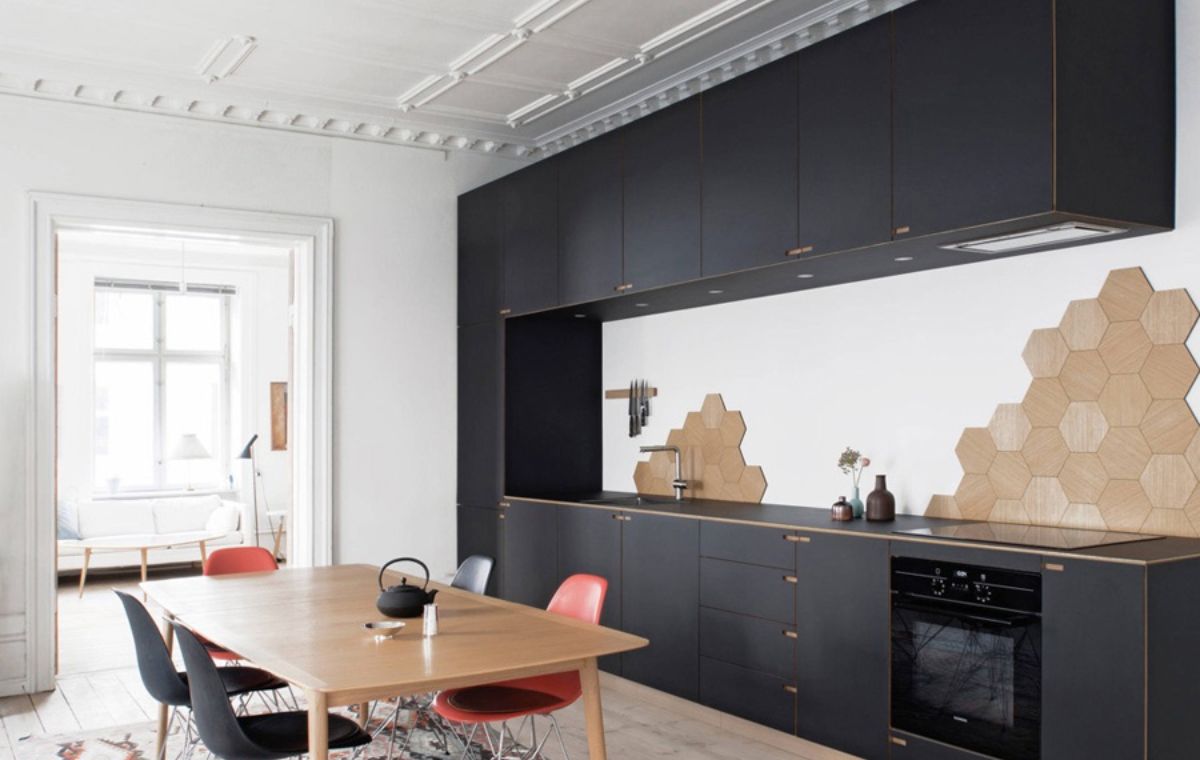
Velvet-touch, soft-touch HPL laminates are the leading finish in premium kitchens in 2026. Scratch-resistant, easy to clean, and they don't show fingerprints the way gloss does. The palette driving this: charcoal grey, bottle green, mocha brown, warm off-whites. These aren't colours that date quickly.
PU lacquer: the premium option
Factory-sprayed two-component polyurethane over MDF, built up in multiple coats with sanding between each. The colour depth is unmatched. The range is effectively limitless. Must be a factory finish; on-site painting never achieves the same result. Novella's finish of choice for high-end builds.
High-gloss acrylic
Still relevant for compact kitchens where light amplification matters, gloss bounces light and makes small spaces feel larger. The practical reality: every fingerprint, every splash, is visible constantly. In a kitchen that sees real use, you'll be wiping surfaces throughout the day.
Natural wood veneer
The only finish that brings genuine organic variation. Teak, oak, walnut — each with distinct character. More maintenance than laminate or lacquer, and shouldn't be exposed to standing water. In a kitchen with good ventilation and considered use, it's the warmest and most characterful option available.
Novella design principle: Limit yourself to two finishes and two hardware metals per kitchen. Beyond that, you're not creating contrast, you're creating visual noise.
Which Countertop Material Is Most Durable for Indian Cooking?
Engineered quartz: best all-rounder
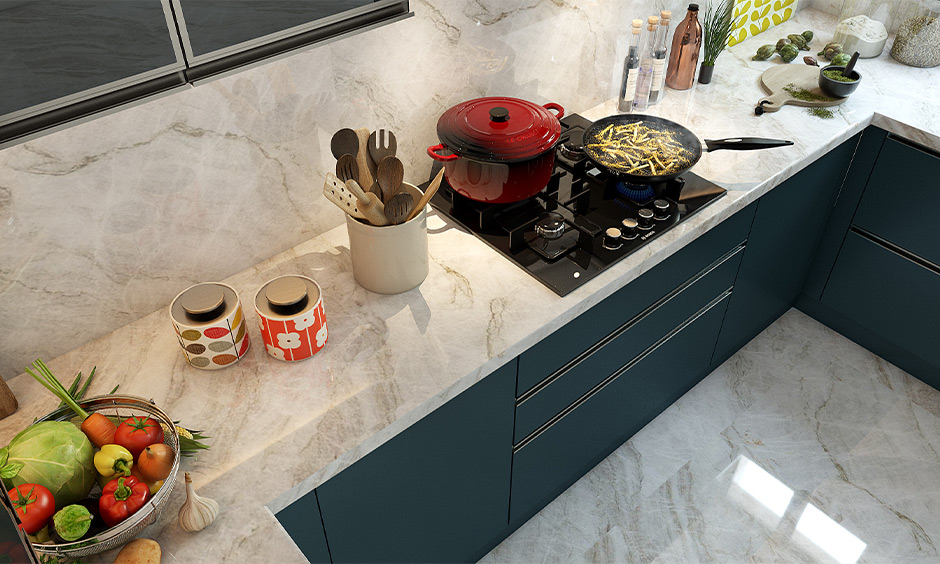
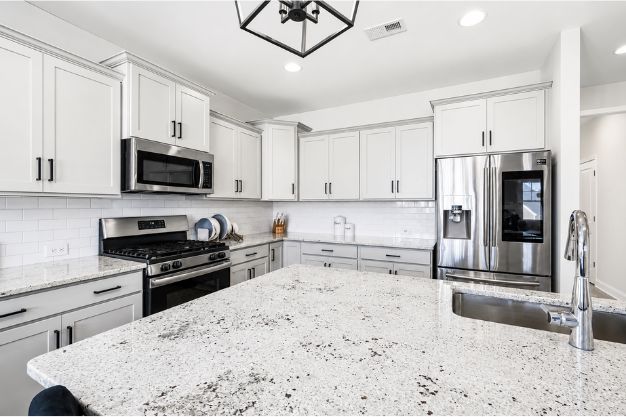
Non-porous, extremely hard, highly stain-resistant, and requires no sealing. The one limitation: thermal shock from very hot pans directly from the hob. Always use a trivet. In every other dimension, quartz outperforms almost every alternative.
Sintered stone: the luxury benchmark
Manufactured through extreme heat and pressure, sintered stone (Dekton, Neolith) is harder than granite, completely non-porous, heat-proof, and UV-stable. The "Quiet Luxury" design trend, monolithic slab islands, and seamless countertop-to-backsplash transitions are built almost entirely around this material. Near-zero maintenance over a decade.
Granite: the Indian classic
India has some of the world's finest granite deposits. Hard, heat-resistant, and with annual sealing, it handles Indian cooking well. It remains a widely used, highly robust natural stone option for Indian residential kitchens.
Marble: accent use only
Etches with acidic liquids. Stains. Scratches relative to quartz and granite. As a primary countertop in an active Indian kitchen, it's a high-maintenance commitment. As an island waterfall edge or visual accent: genuinely beautiful.
Read more:- Your Go-To Guide for Kitchen Cabinet Materials and Finishes
|
Material |
Heat Resistance |
Scratch Resistance |
Maintenance |
Performance Tier |
|
Quartz |
Very Good |
Excellent |
Very low |
All-Rounder |
|
Granite |
Excellent |
Very Good |
Low (seal annually) |
Heritage Classic |
|
Sintered Stone |
Excellent |
Excellent |
Minimal |
Ultra-Premium |
|
Quartzite |
Excellent |
Very Good |
Moderate |
High-End Natural |
What Kitchen Hardware Makes the Most Difference to Long-Term Performance?
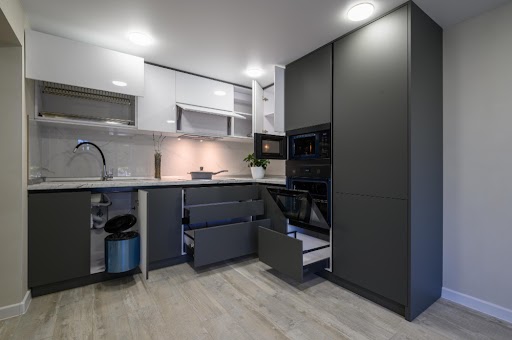
German-engineered hardware from Hettich, Blum, and Häfele sets the global benchmark. Soft-close hinges rated to 100,000+ cycles. Full-extension drawer channels with integrated dampening. The difference between this and alternative hardware isn't visible on day one. By year three, it's obvious.
In 2026, the dominant aesthetic is handleless J-pull profiles, G-profiles, or push-to-open systems. Where handles are used, the trending finishes are brushed brass and matte black. Mixed metals, done with restraint, look intentional. Done without restraint, they look like indecision.
Novella specifies Hettich and Häfele hardware across all kitchen tiers, one of the foundations of the 10-year manufacturing warranty we offer on every build.
How Much Does a Modular Kitchen Cost in India in 2026?
|
Segment |
Carcass |
Finish |
Countertop |
Total Project Range |
|
Premium Core |
BWR plywood |
Premium laminate/acrylic |
Engineered quartz |
₹6.0L–7.5L |
|
High-End Design |
BWR plywood / HDHMR |
PU lacquer / veneer |
Premium quartz / sintered stone |
₹7.5L–12.0L |
|
Luxury Signature |
Marine plywood / WPC |
2K PU lacquer |
Sintered stone/quartzite slab |
₹12.0L+ |
Figures cover cabinetry, shutters, hardware, countertop, and installation. Appliances and civil work are additional. For a personalised estimate, use the Novella Kitchen Cost Calculator →
Conclusion
The formula isn't complicated. Start with the right core, BWR plywood for most builds, WPC where moisture is a persistent problem. Choose a finish suited to how you actually live, matt laminates for heavy-use family kitchens, lacquer for spaces where aesthetics drive the brief. Specify German hardware regardless of your design setup. That combination is what earns a kitchen its cost over ten years.
At Novella Kitchens, we've built on exactly this approach from our Gurgaon facility: European design, German manufacturing precision, and materials specified for the realities of Indian homes. Every kitchen we deliver carries a 10-year warranty on manufacturing defects, because the process we've built gives us the confidence to back it.
Frequently Asked Questions
Q1 Which material is best for modular kitchen cabinets in India?
BWR-grade plywood is the best carcass material for Indian kitchens in 2026. It combines moisture resistance, structural strength, and dimensional stability, the three qualities that matter most in Indian environments. For door shutters, use MDF as the substrate for lacquered and painted finishes.
Q2 Is WPC better than plywood for modular kitchens?
WPC outperforms plywood on moisture and termite resistance; it's genuinely waterproof, whereas BWR plywood is water-resistant. For coastal cities or high-humidity zones, WPC is the preferred choice. For standard Delhi NCR apartments, well-specified BWR plywood performs excellently.
Q3 Which countertop is most durable for Indian cooking?
Sintered stone is the most durable option available in 2026, being heat-proof, scratch-resistant, and non-porous. For balanced project plans, engineered quartz is an excellent practical choice: no sealing required, exceptional stain resistance, and widely available in India.
Q4 What materials does Novella Kitchens use?
Novella uses 18mm BWR-grade plywood for all carcasses with 2mm ABS edge banding, MDF or HDF substrates for lacquered door shutters, and Hettich/Häfele hardware throughout. Countertops are specified per project: engineered quartz for premium core builds and sintered stone for high-end or luxury applications. All production runs on Homag and Altendorf German CNC machines at our Gurgaon facility.
Q5 What is the starting cost of a premium modular kitchen in Gurgaon in 2026?
A well-appointed modular kitchen utilising a BWR plywood carcass, high-grade finishes, German soft-close hardware, and a durable engineered stone countertop begins at approximately ₹6.0L, scaling upwards based on size, layout complexity, and advanced finish selections like PU lacquer or sintered stone.