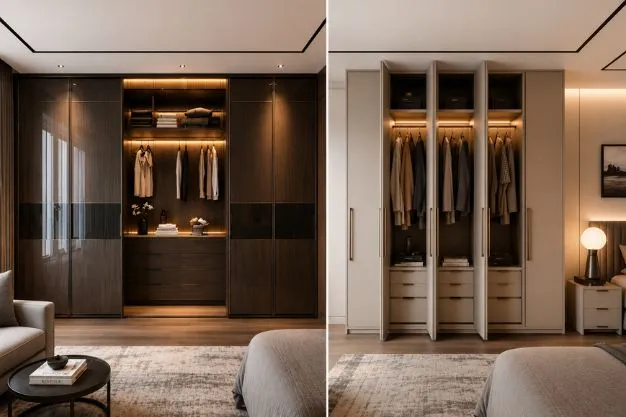
Hinged vs Sliding Wardrobe Doors: Room Size & Hardware Guide
Quick Answer: Hinged wardrobe doors offer full-width access and suit rooms with at least 90–100 cm of clearance in front of the wardrobe. Sliding doors are better for compact bedrooms under 100 sq ft, require no swing space, and work best with quality hardware to prevent noise and track wear. The right choice depends on your room dimensions, how you use the wardrobe, and the hardware grade — not just aesthetics.
Should You Choose Hinged or Sliding Wardrobe Doors? The Complete Space, Hardware, and Climate Guide
Most homeowners choose between hinged and sliding wardrobe doors based on what looks good in a showroom. But wardrobe door design is a structural and functional decision one that affects how accessible your storage is daily, how well the door performs years from now, and whether your wardrobe works with your room's layout.
This guide covers what standard comparisons leave out: room-size thresholds for Indian bedrooms, hardware differences that separate a well-built door from one that fails, climate-specific considerations, and a third option, hybrid wardrobes, that most guides never mention.
Hinged vs Sliding Wardrobe Doors: Side-by-Side Comparison
|
Feature |
Hinged Wardrobe Doors |
Modular Wardrobe Sliding Doors |
|
Floor clearance needed |
90–100 cm in front of the wardrobe |
None — doors move along the frame |
|
Minimum room size |
120 sq ft or more |
Suitable from 80 sq ft |
|
Access width per opening |
Full compartment width |
50–60% of total width at a time |
|
Mirror panel compatibility |
Full-length mirror on each shutter |
Full-length mirror on sliding panels |
|
Maintenance |
Hinge alignment every 2–3 years |
Track cleaning + roller check every 6–12 months |
|
Noise potential |
Minimal with soft-close hinges |
Moderate — depends heavily on roller grade |
|
Best for |
Dressing rooms, large bedrooms, walk-ins |
Compact bedrooms, shared rooms, open-plan areas |
|
Premium hardware brands |
Hettich, Grass, Blum |
Hettich, Hafele, King Slide |
Read more: TV Wardrobe Design
How Do Hinged and Sliding Wardrobes Interact With Your Bedroom Layout?
The difference between hinged and sliding wardrobe doors is not just visual; it is fundamentally about how your wardrobe interacts with the space around it.
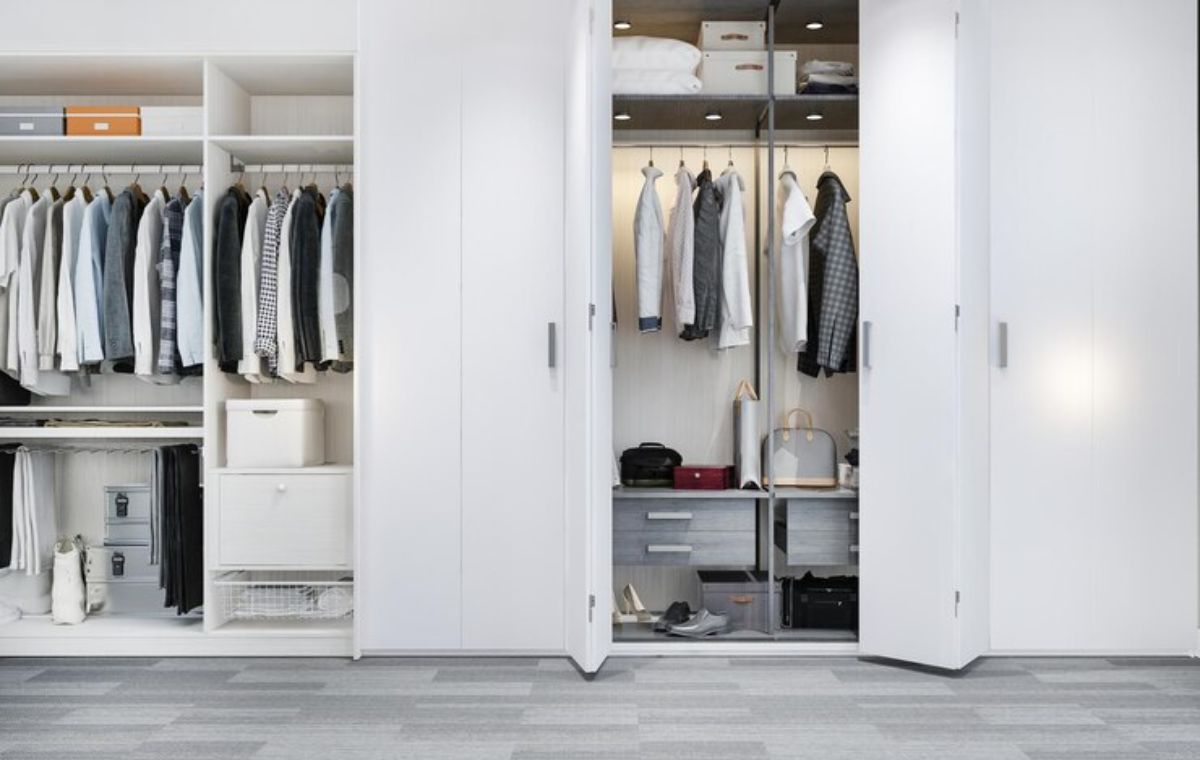
Hinged wardrobe doors swing outward on pivot hinges. Each shutter opens to reveal its entire compartment, giving unrestricted access to the full depth and width of the storage behind it. The trade-off is the swing arc — typically 45 to 90 degrees — which requires clear floor space in front to function without obstruction.
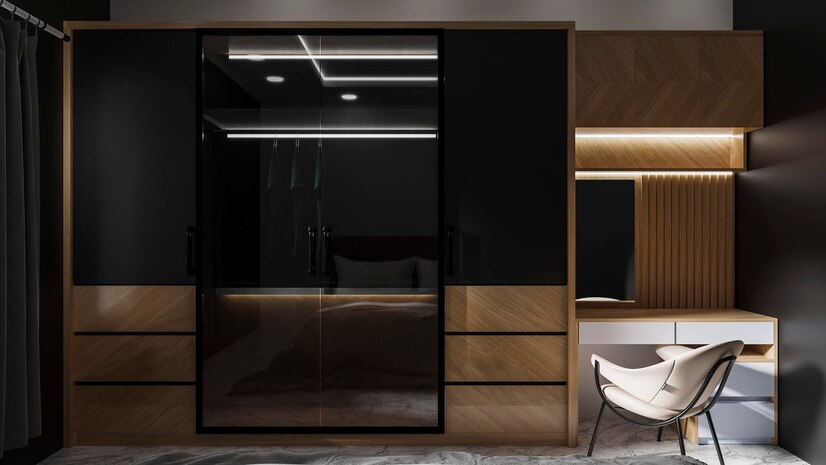
Modular wardrobe sliding doors run along a track mounted at the top and bottom of the frame. Panels slide left or right to reveal one section at a time. Because they move parallel to the wardrobe face rather than outward, they require zero floor clearance. The limitation is simultaneous access, you can only open one side at a time.
The choice is not about one being superior. It is about which works with your room's actual dimensions, your daily usage pattern, and the quality of hardware the wardrobe is built with.
What is the Minimum Room Size and Clearance Needed for Hinged Wardrobe Doors?
Hinged wardrobe doors are best suited to bedrooms with enough depth to accommodate the door swing without disrupting movement.
As a practical guide for Indian homes, a standard 2-door hinged wardrobe with 600 mm deep shutters requires approximately 90–100 cm of clear floor space in front. In a bedroom where the wardrobe faces the bed, that clearance must exist between the bed edge and the wardrobe face. Rooms under roughly 100–110 sq ft typically cannot accommodate this without a shutter hitting furniture.
Where hinged doors excel:
Walk-in wardrobes and dressing rooms — when the wardrobe lines an entire wall and you need to access multiple compartments in sequence, hinged doors let you open everything simultaneously. This is particularly valuable when multiple family members share a wardrobe with distinct sections.
Deep wardrobes over 600mm — full-height hinged shutters let you see and reach the complete interior depth without a panel blocking part of the opening.
Rooms with high ceilings — floor-to-ceiling hinged doors create a strong vertical statement and can be built without visible top tracks, a significant advantage in luxury wardrobe door installations.
Why Are Modular Sliding Wardrobes the Best Choice for Compact Indian Bedrooms?
Modular wardrobe sliding doors are the practical default for most Indian urban bedrooms, where room sizes in newer apartment layouts have reduced considerably. A standard 2BHK bedroom in most metro cities today ranges from 100 to 130 sq ft, often too tight for hinged shutters on a 6-foot wardrobe without compromising movement space.
Sliding doors solve this without compromise. They occupy zero additional floor space when open, which is why they dominate modular wardrobe design in apartments built from 2010 onward.
When sliding works best:
Shared bedrooms — children's rooms and guest rooms often have limited clearance. Sliding doors eliminate the risk of a shutter hitting a desk, chair, or someone walking past.
Wardrobes wider than 6 feet — wider runs with hinged shutters require either narrow panels that look awkward or large, heavy shutters that stress the hinges over time. Sliding panels handle wider spans more elegantly.
Open-plan spaces — in studio apartments or open-plan configurations- sliding wardrobe doors maintain visual continuity, reading as a flat wall panel rather than a furniture piece when closed.
Which Wardrobe Hardware Brands and Specifications Prevent Track Wear and Door Misalignment?
A sliding wardrobe built with premium ball-bearing rollers and an anodised aluminium track will operate silently and smoothly for 10 to 15 years. The same wardrobe built with generic nylon rollers and a painted steel track will develop noise, resistance, and misalignment within two to three years — particularly in Indian humidity conditions.
For sliding door hardware, evaluate:
- Roller type — ball-bearing rollers are rated for 30,000 to 50,000 operating cycles; nylon rollers have no rated cycle life and wear against the track, creating noise and debris
- Track material — anodised aluminium resists corrosion and maintains dimensional stability; painted steel develops friction points over time
- Track load capacity — premium top-hung systems are rated for panels up to 80–100 kg, essential for mirror or thick glass panels
- Anti-jump guides — prevent panels from derailing if the wardrobe is bumped or if the floor settles
- Soft-close mechanism — decelerates the panel in the final 8–10 cm of travel, producing near-silent closure
For hinged door hardware, evaluate:
- Hinge grade — premium hinges include 3D adjustment (up/down, left/right, depth) so doors can be realigned without removal
- Soft-close dampers — integrated dampers slow the shutter in the last 15–20 degrees of closure, protecting both hinge and carcass from repeated impact
- Load rating — full-height mirror shutters can exceed 20–25 kg, requiring higher-rated hinges or additional hinge points
Brands worth specifying: Hettich and Hafele for sliding systems; Hettich, Grass, and Blum for hinged hardware. The difference between branded and generic hardware is not marginal; it is the difference between a wardrobe that performs identically in year eight as it did in year one, and one that needs a carpenter call every monsoon season.
Humidity and Indian Climate: What Your Wardrobe Guide Won't Tell You
India's climate creates wardrobe conditions that no Western guide addresses. In coastal cities, Mumbai, Chennai, Kochi, Vizag, ambient humidity can exceed 80% for months at a time. In Delhi-NCR and Bengaluru, four to five months of high humidity annually affect the performance of both door types.
Painted steel tracks corrode — surface corrosion creates friction on the track, which directly causes roller noise and resistance. In coastal locations, this can begin within 18–24 months on unprotected steel.
Panel cores expand — standard MDF and particleboard absorb moisture and can cause panels to bind in their tracks. Quality builds use moisture-resistant (MR-grade) core materials rather than standard grades.
What to specify for Indian conditions: anodised aluminium tracks (not painted steel), ball-bearing rollers with stainless steel balls, and MR-grade panel cores throughout. For hinged wardrobes in humid environments, 316-grade stainless steel or polymer-encased hinge bodies resist oxidation significantly better than standard zinc alloy or chrome-plated steel hinges.
The Hybrid Wardrobe: The Third Option Nobody Mentions
A hybrid wardrobe combines both door types in a single unit. It is common in Indian modular installs — particularly in larger wardrobes and walk-in configurations — and entirely absent from every standard wardrobe comparison guide.
A 2.4-metre wardrobe might use sliding panels across the main hanging and shelving section (wider, frequently accessed) and hinged doors on a narrower end section for accessories or less-used storage. A walk-in can use hinged doors on interior sections for full compartment visibility, with sliding panels on the entrance face that close cleanly when the room hosts guests.
The construction uses the same carcass throughout. Sliding track hardware integrates into the top and bottom of the frame for one segment; hinge hardware mounts to partition walls for the other. The two systems operate independently. The key structural requirement is that the partition dividing them is adequately built to carry both hinge loads on one face and panel weight transmitted through the frame on the other.
What is the Final Verdict on Hinged vs Sliding Wardrobes for Indian Homes?
Choosing between hinged and sliding wardrobe doors isn't just an aesthetic choice, it is a spatial and structural blueprint for your bedroom.
- The 100 Sq Ft Threshold: If you are dealing with a compact modern apartment under 110 sq ft, sliding doors are the non-negotiable default to save your walking space.
- The Full-Access Luxury: If you have the luxury of a 120+ sq ft room or a dedicated walk-in closet, hinged doors offer an unmatched, full-width view of your wardrobe that makes daily organising effortless.
- The Microclimate Factor: Never forget that in India's intense humidity cycles, your wardrobe is only as good as its moving parts. Skipping out on premium, corrosion-resistant hardware from trusted brands like Hettich, Hafele, or Blum means planning for a mechanical failure within a few monsoons.
Ultimately, your room layout dictates the style, but your choice of hardware dictates the lifespan. Assess your floor clearance, invest in moisture-resistant materials, and don't hesitate to explore a hybrid wardrobe if your space demands a mix of both worlds.
How to Get Expert Wardrobe Design Solutions in Delhi-NCR
If you are looking to design a wardrobe that perfectly balances your bedroom’s dimensions with premium engineering, connect with the experts at Novella.
As a leading modular wardrobe manufacturer in Gurgaon, Novella specialises in crafting luxury wardrobe doors, high-end fitted wardrobe systems, and custom storage solutions tailored to premium residential projects across Delhi-NCR. Contact Novella today to transform your bedroom layout with wardrobes built to endure the Indian climate beautifully.
FAQ
Q1 Which wardrobe door type is better for a small bedroom?
For bedrooms under 100–110 sq ft, standard in most metro 2BHK apartments, sliding wardrobe doors are the practical choice. Hinged shutters need 90–100 cm of clear floor space to open fully, which a compact room facing a bed rarely has. Sliding doors use zero floor space and give you identical storage capacity.
Q2 Do sliding wardrobe doors make noise?
Only with lower-grade hardware. Noise comes from nylon rollers wearing against the track or from painted steel tracks corroding. Premium sliding systems with ball-bearing rollers and anodised aluminium tracks are functionally silent for years. Maintain them with a dry PTFE lubricant applied to rollers annually — not oil-based, which collects dust.
Q3 Can I fit full-length mirrors on both door types?
Yes. Full-height mirror panels work on both hinged and sliding systems. For sliding doors, a full-height mirror panel can weigh 25–35 kg, specify a top-hung system rated for at least 60–80 kg per panel to carry it safely long-term.
Q4 Which is better for renters?
Hinged wardrobe doors are generally better for renters, simpler to remove and reinstall without leaving track hardware in floors and ceilings. For owners, choose based on room size and usage; both systems last 10–15 years with quality hardware.
Q5 Is a hybrid wardrobe possible?
Yes, and more common than most guides suggest. A hybrid uses the same carcass throughout, with sliding and hinged sections operating independently. Any experienced modular wardrobe manufacturer in Gurgaon can build this — ask for it in the design brief.